
In the world of higher education marketing, one constant is change! Some of the challenges we faced this year included changes to platforms, enhancements to AI, and the impact of FAFSA updates.
As we look to 2025, I took a look at a few challenges for university MarComm leaders to consider as we navigate our work.
Thoughts from Others
First, I wanted to share a few predictions from others in the industry. My friend Devin Purgason wrote about his predictions in this InsideHigherEd Call to Action blog post.

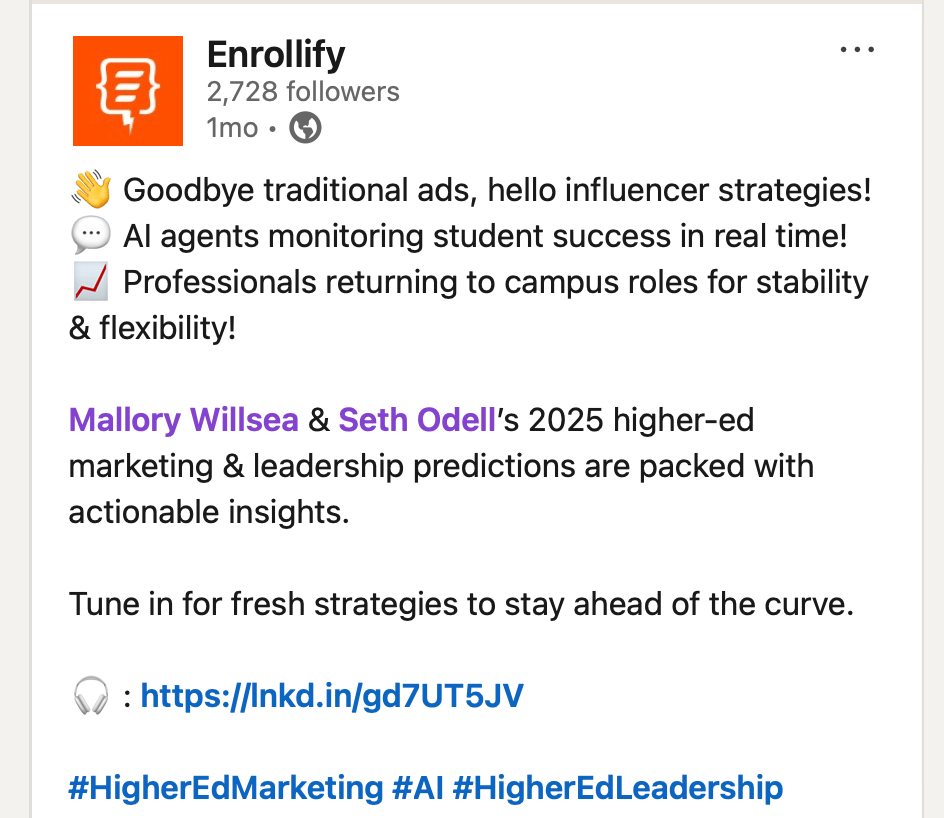
Also — Mallory Willsea and Seth Odell drop their predictions in this Enrollify Higher Ed Pulse series.
My 2025 Predictions
Here are the three challenges that I think are going to be prevalent challenges for MarComm teams. While all of these challenges have been discussed before by various leaders in the space, I think new developments will keep them as some of the top issues that MarComm teams will need to navigate.
1. Start of the Enrollment Cliff – The number of high school graduates is expected to peak in 2025 and continue declining through 2037. With the enrollment cliff starting in 2025 and the fallout from the FAFSA, I think we are going to see more pressure on institutions for students. For some institutions that will mean closure, but for others it will mean evaluating recruitment methods (thinking about the NACAC ethic change allowing the recruitment of students when they enrolled elsewhere). I also think universities are going to begin exploring ways to diversify from traditional college-age students to alternate models and alternate student types. I think micro-credentials, certificates, programs that are partnerships with the community, and other learners (transfer, nontraditional, stop outs) will all become a bigger focus.
2. Influencer Marketing in Higher Ed – Higher Education has begun toying with how to use students as influencers for several years, but I think we’ll see much more of that in 2025. My guess is that the institutions that do this well will develop plans that go beyond the content. They’ll consider this strategy with an awareness of the broader challenges. Some of those challenges include hiring students, liability, training, and even content ownership. Student influencers intersect with the NIL conversation if the influencers are athletes, which makes this even more complicated. Because of these factors, I believe that universities looking to expand their influencer marketing approach will turn to external partners to help in policy development, vetting students, and managing potential issues if these students misstep.
3. AI Streamlining and Regulations – My final prediction is that AI will reach a new level of maturity in 2025. Much like the internet took a few years of being the “Wild West” before regulations and guard rails were implemented, I think the same is going to play out in the world of AI. My guess is this year we’ll start to get answers of how copyright and intellectual property are handled. I also think we’ll begin to see advances around security and what goes into the model, which will allow companies to input private or proprietary data. This change means the output that organizations can achieve in analysis and modeling will allow for more innovation. Another change I think we’ll begin to see in AI is the streamlining of tools. There are dozens of tools popping up each month, and I think we’ll start to coalesce around a few key tools, as the owners of those tools buy out other tools in an effort to provide increased functionality.
What Else?
I’ve listed my top three predictions but am curious what you’re thinking about. Feel free to add a comment and share a prediction you’re thinking about as we head into 2025.
 And Carrie On